Executive Summary
- Plastics and polymers are ideal materials for firearm products because they cut weight, eliminate corrosion, absorb shock, and maintain tight tolerances.
- Defense and aftermarket manufacturers gain molded-in customization, streamlined assembly, and direct fulfillment from a single-source molding workflow.
- American Plastics provides industry-leading thermoplastic injection molding for defense & aftermarket firearm products.
Single-Source Firearm Plastic Injection Molding Services
Defense manufacturers routinely spend months locating molders with the right equipment for firearm work. Most shops lack the press range or ISO-certified quality systems needed for defense work. A wrong choice delays timelines and causes parts to crack under recoil or heat.
At American Plastics, we’re an ISO 9001:2015 plastic injection molder. We produce polymer firearm components ready for assembly without secondary machining steps. Our single-source workflow handles design, tooling, molding, and fulfillment without outside vendors.
Read on to learn why more defense contractors, aftermarket component brands, and firearm manufacturers choose American Plastics as their go-to thermoplastic injection molding company.
Request a Quote for Defense & Aftermarket Firearm Plastic Injection Molding
Benefits of Plastic Injection Molded Firearm & Defense Parts
Injection-molded polymer parts cut firearm weight, eliminate rust, and absorb shock from recoil and drops. Parts molded from polymer also maintain tight tolerances across high-volume runs and undercut machining costs.
Polymer Advantages
- Made from resins: Engineering-grade polymers such as polycarbonate and nylon withstand the heat generated inside weapon housings. ABS, Acetal, and Santoprene fill structural and aesthetic roles beyond what standard commodity resins allow.
- Lightweight: Sights, grips, and stocks molded from polymer weigh significantly less than aluminum or steel equivalents. Thin-wall designs and internal ribs trim ounces from the overall weapon system without sacrificing durability.
- Won’t corrode: Salt spray, humidity, and cleaning solvents degrade metal finishes but leave engineered plastics intact. Firearm components exposed to harsh environments maintain function and appearance longer when formed from corrosion-resistant resins.
- Absorbs shock: Buttstocks and grip panels compress under recoil impact instead of transmitting energy directly to the shooter. Resilient polymers recover their original shape after absorbing thousands of compression cycles.
- Holds tight tolerances: Thermoplastic injection molding produces identical dimensions within thousandths of an inch across every cavity in a multi-cavity tool. Consistent wall thickness and gate placement ensure sights, rails, and housings mate correctly with metal frames.
- Decreased Costs: Multi-cavity molds produce thousands of identical firearm components per cycle with minimal labor input. Tooling approval eliminates setup fees, secondary operations, and material scrap.
Why This Matters
Injection-molded polymer material gives firearm manufacturers lighter weapons, longer component life, and tighter fitment when specified for suitable components. These gains translate directly into reduced operator fatigue, lower maintenance schedules, and reliable function under stress.
A True Plastic Injection Molding Partner for Firearms & Defense
American Plastics provides precision firearm and defense thermoplastic injection molding services for the private and public sectors. Thirteen presses and ISO-certified quality systems let us mold tight-tolerance parts from engineering resins for defense components. Our team assists with design, partners with a regional tool shop, and verifies dimensions with a MicroVu video coordinate measuring machine.
Full-Service Plastic Injection Molding Services
We offer the following molding, packaging, and distribution services:
- Defense and aftermarket firearm components come off our presses at tolerances tight enough for critical-fit applications. Thirteen presses, ranging from 55 to 400 tons, perform scientific molding, traditional molding, and insert-over molding to meet those tolerances in high-volume production.
- Nylon, polycarbonate, ABS, Acetal, and Santoprene give firearm housings, grips, and sights the heat resistance and impact strength they need. We select the resin to match your component, rather than forcing a standard material into a job it cannot handle.
- Our regional tooling partner machines molds with precision CNC equipment and optimized surface finishes to reduce waste and improve cycle times. Complex defense geometries that would require secondary machining elsewhere come out of the mold closer to net shape.
- Ultrasonic welding, insert-over molding, and in-house assembly join multiple components into finished products without adhesives or fasteners. Your parts arrive assembled and tested rather than as loose pieces requiring downstream labor.
- We offer comprehensive packaging and distribution services that move finished products directly from our floor to distribution warehouses. You skip the cost of managing a separate fulfillment vendor while capturing the time savings of drop-shipped delivery.
Molded-In Customization for Aftermarket Firearm Parts
Aftermarket manufacturers color-code magazine followers and baseplates to distinguish caliber at a glance. We mold those color distinctions directly into the resin instead of applying paint or labels that peel under solvent exposure. Brand logos and model numbers are formed as raised or recessed features on the mold surface and withstand abrasion that would destroy printed graphics.
Attachment interfaces like Picatinny rails and M-LOK slots mold with the correct geometry and spacing built in. This eliminates the need for separate machining, drilling, or tapping steps that metal assemblies require. Your aftermarket parts arrive ready to mount on standard weapon platforms without additional hardware or fitting.
Why Partner with American Plastics?
Our single-source workflow handles design/tooling, molding, assembly, and fulfillment under one ISO-certified roof. That consolidation cuts lead times, reduces vendor count, and keeps your defense program on schedule.
Types of Firearm Parts Ideal for Plastic Injection Molding
Many non-load-bearing firearm components perform better when fabricated from engineered resins rather than machined metal. Thermoplastic injection molding produces sights, grips, rails, stocks, magazines, and trigger housings with surface textures and internal ribs that machining cannot match at comparable cost.
Common Molded Components
- Fiber-optic and red-dot sight housings are molded precisely from transparent or colored resins. Polymer enclosures withstand recoil vibration while integrating illumination features directly into the part.
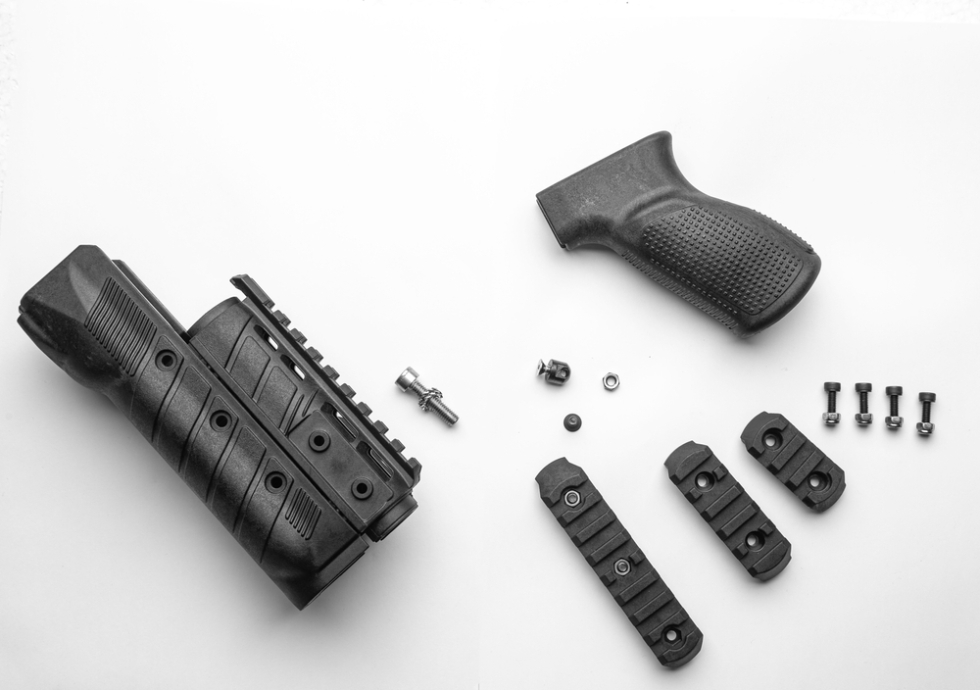
- Textured pistol grips and foregrips are formed from nylon or ABS with checkering molded directly into the surface. Shooters maintain control in wet or gloved conditions without adding the weight of machined aluminum.
- Picatinny rails and M-LOK attachment points are molded from glass-filled nylon to resist heat and support accessory weight. Polymer handguards insulate the support hand from barrel heat better than aluminum equivalents.
- Buttstocks and cheek rests mold as hollow structures with internal ribs to cut ounces from the overall weapon system. Recoil pads formed from resilient polymers compress under impact and return to shape across thousands of rounds.
- Magazine bodies, floor plates, and followers form from slippery, low-friction resins that promote reliable feeding. Consistent wall thickness and uniform dimensions across high-volume runs reduce jamming caused by warped or inconsistent metal stampings.
- Polymer trigger guards and lower receiver housings are molded with complex internal geometries that would require multiple machining setups in metal. Molded housings drop weight at the rear of the firearm and resist corrosion from sweat or cleaning solvents.
We Mold Complex Firearm Shapes
The correct polymer firearm components maintain precision fit and resist corrosion without adding machining steps. Our engineers select resins and design tooling so your polymer parts drop into your assembly and withstand recoil, heat, and chemical exposure.
Lightweight Plastics vs Metal Alloys
Engineered resin costs less per pound than aluminum or steel stock on high-volume defense contracts. Molded parts eliminate the costs of anodizing, coating, and secondary milling associated with metal machining. Cycle times measured in seconds replace hours of setup and cutting time after initial tooling approval.
Bare hands gripping machined aluminum handguards can freeze within minutes in subzero field conditions. Polymer grips stay neutral to the touch and absorb sound from rocks or vehicle frames. Hard metal components dent permanently when dropped against concrete. Dropped polymer springs back to its original shape without visible cracking or permanent deformation.
Polymer replaces machined metal in firearm components to cut weight, cost, and noise. You gain the most from polymer grips, stocks, and handguards in rough handling and cold weather. Engineers on our team review your assembly and select resins for field heat, impact, and chemical exposure.
Choose American Plastics For Defense & Firearm Plastic Injection Molding
Thermoplastic injection molding for defense and aftermarket firearm products cuts weight, eliminates corrosion, and holds tight tolerances. Machined metal cannot match these gains at comparable cost or production speed.
American Plastics operates thirteen presses from 55 to 400 tons for defense and aftermarket firearm molding. Our team handles design, tooling, molding, assembly, and fulfillment without outside vendors.
Click below for a quote and to learn more about plastic injection molding for your defense or aftermarket firearm program.
Request a Quote for Defense & Aftermarket Firearm Plastic Injection Molding